Ottawa vs Pittsburgh Knee Rules title image comparing knee x-ray decision rules for acute knee injuries.

MDCalc Wars: Ottawa vs Pittsburgh — Which Knee Rule Should You Use?

🧭 REBEL Rundown

🗝️ Key Points

  • 🦵 Not every acute knee injury needs an x-ray — decision rules can help reduce unnecessary imaging while maintaining patient safety.
  • 📏 Ottawa Knee Rule = highly sensitive rule-out tool — best when you want the most widely validated approach, but it may lead to more x-rays.
  • 🎯 Pittsburgh Knee Rule = more specific trauma-focused option — useful after blunt trauma or a fall and may reduce unnecessary radiographs compared with Ottawa.
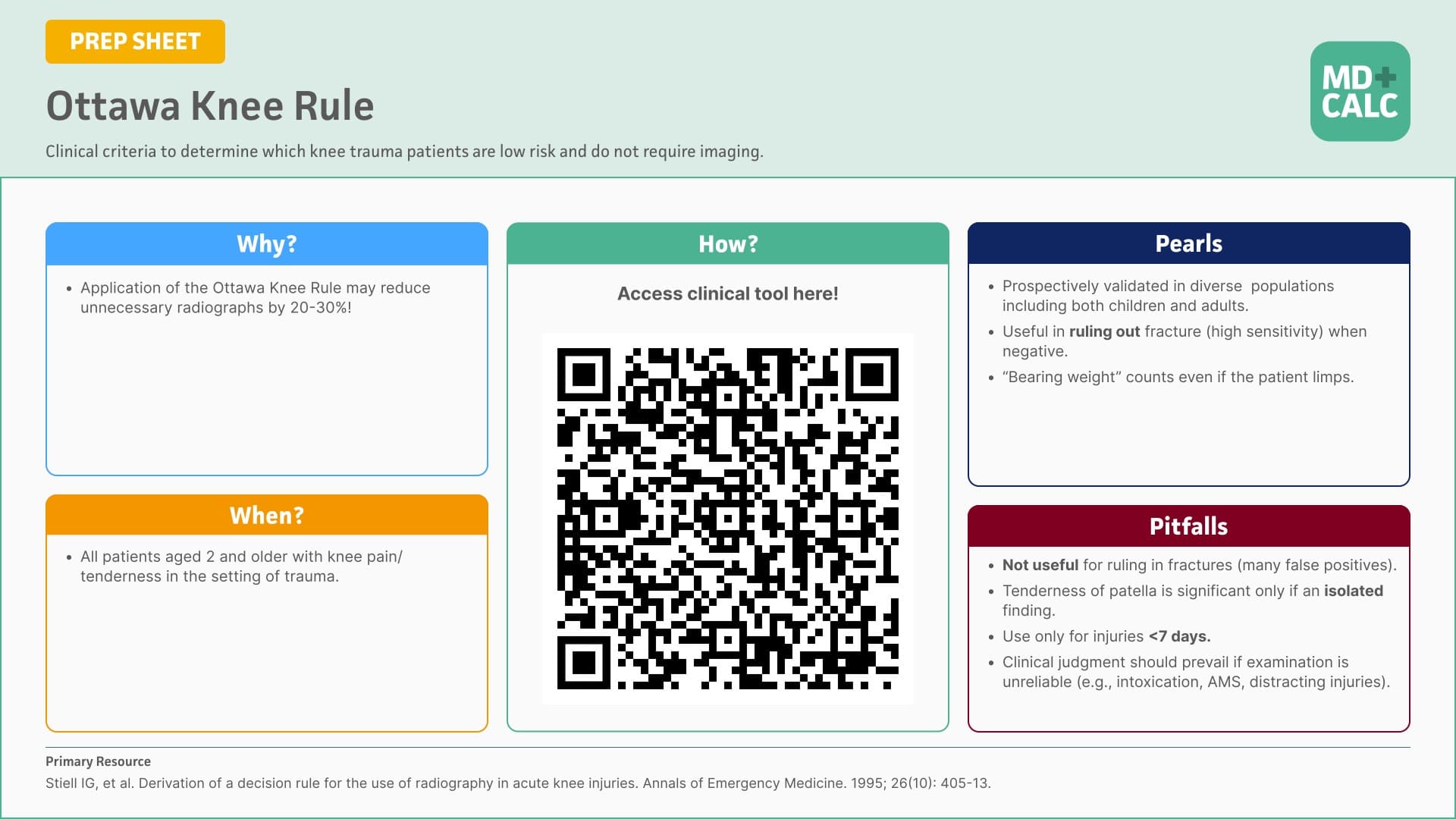
  • ⚠️ Know the pitfalls — Ottawa applies to injuries <7 days, isolated patellar tenderness matters, and limping still counts as bearing weight.
  • 🧠 Use clinical judgment when the exam is unreliable — intoxication, altered mental status, distracting injuries, or concerning findings should override the rule.

🤕 Case

A 42-year-old man presents after stepping into a classic New York City pothole while crossing the street, twisting his knee and falling forward. He has pain with ambulation but was able to limp into the ED. On exam, there is mild swelling, focal tenderness over the patella, and he can take a few guarded steps. You pause before ordering imaging and reach for a decision rule to determine whether this patient truly needs an x-ray.

🔗 Scoring Tools

🎯 Quick Hits

Comparison chart of the Ottawa and Pittsburgh Knee Rules for knee x-ray decisions, including performance, workup, and common pitfalls

💬 Case Resolution

Using the Ottawa Knee Rule, his isolated patellar tenderness makes the rule positive, so you obtain an x-ray, which ultimately shows no fracture and allows for safe discharge with supportive care and follow-up.

🚨 Clinical Bottom Line

  • Ottawa: Go-to rule for most adult knee injuries when you want a highly sensitive, widely validated rule-out tool. You will catch essentially all fractures, at the expense of more x-rays.
  • Pittsburgh: Best for trauma-specific knee injuries when you want a simpler, more specific rule. Similar sensitivity, but may help reduce unnecessary imaging compared to Ottawa.

Post Peer Reviewed By: Marco Propersi, DO (Twitter/X: @Marco_Propersi), and Mark Ramzy, DO (X: @MRamzyDO)

❓ FAQ

  1. When should I use the Ottawa Knee Rule?
    Use the Ottawa Knee Rule for adult patients with an acute knee injury when you want a highly sensitive, widely validated rule to help decide whether knee x-rays are needed.
  2. When should I use the Pittsburgh Knee Rule?
    Use the Pittsburgh Knee Rule after a blunt trauma or fall, especially when you want a simpler rule that may reduce unnecessary x-rays compared with Ottawa.
  3. What makes the Ottawa Knee Rule positive?
    The rule is positive if the patient has any of the following: age ≥55, isolated patellar tenderness, fibular head tenderness, inability to flex to 90°, or inability to bear weight for 4 steps immediately after injury and in the ED.
  4. What makes the Pittsburgh Knee Rule positive?
    The rule is positive if the injury occurred after blunt trauma or fall and the patient is either age <12 or >50, or is unable to walk 4 weight-bearing steps in the ED.
  5. Can a patient “bear weight” if they are limping?
    Yes. Limping still counts as bearing weight if the patient can take 4 weight-bearing steps. Clinical judgment should still prevail if the exam is unreliable or the patient appears higher risk.

🧭 Prep Sheets

👤 Author

🔎 Your Deep-Dive Starts Here

Showing Slide 1 of 7
Cite this article as: Eric Steinberg DO, MEHP, "MDCalc Wars: Ottawa vs Pittsburgh — Which Knee Rule Should You Use?", REBEL EM blog, April 27, 2026. Available at: https://rebelem.com/ottawa-vs-pittsburgh-knee-rules/.
Don’t Miss a Post – Follow Us
Want to support rebelem?
Get new posts (free)

1 email per week. No spam.

Sponsored